 CureMyPlants
White Powder on Rose Leaves: How to Spot, Treat and Stop Rose Powdery Mildew
A dusty white film on the newest leaves and buds is almost always rose powdery mildew. Here is how to be sure, the active ingredients that actually clear it, and the simple habits that keep it from coming back.
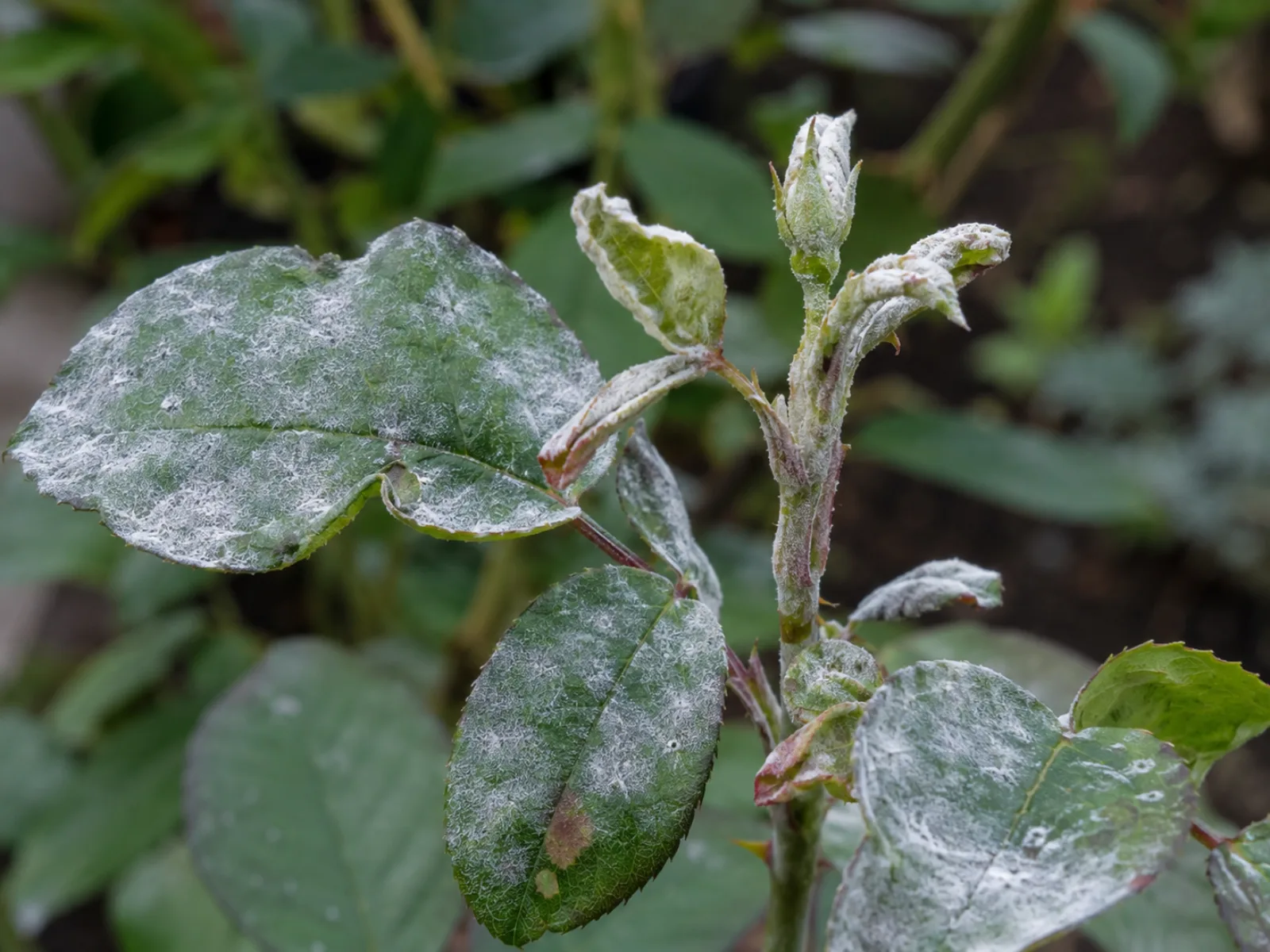
Diagnosis at a glance
Your rose has a white, powdery coating on its newest leaves and buds. This is rose powdery mildew, one of the most common rose problems and one of the most treatable. It is not a sign that your plant is dying, and with a few simple steps you can clear it and keep it from coming back. Below is how to identify it, what causes it, and the treatments and habits that genuinely work.
What it looks like and how to identify it
Rose powdery mildew shows up as a white, powdery coating on the surface of leaves, buds, petals, shoots and young canes.5 It appears first on the youngest tissue: new shoot tips, young leaves and flower buds.14 Infected young leaves often curl, pucker or distort, and they can take on a reddish or purplish tint before the white coating becomes obvious.5 A heavy infection saps the plant's vigour and can stop buds from opening properly.5
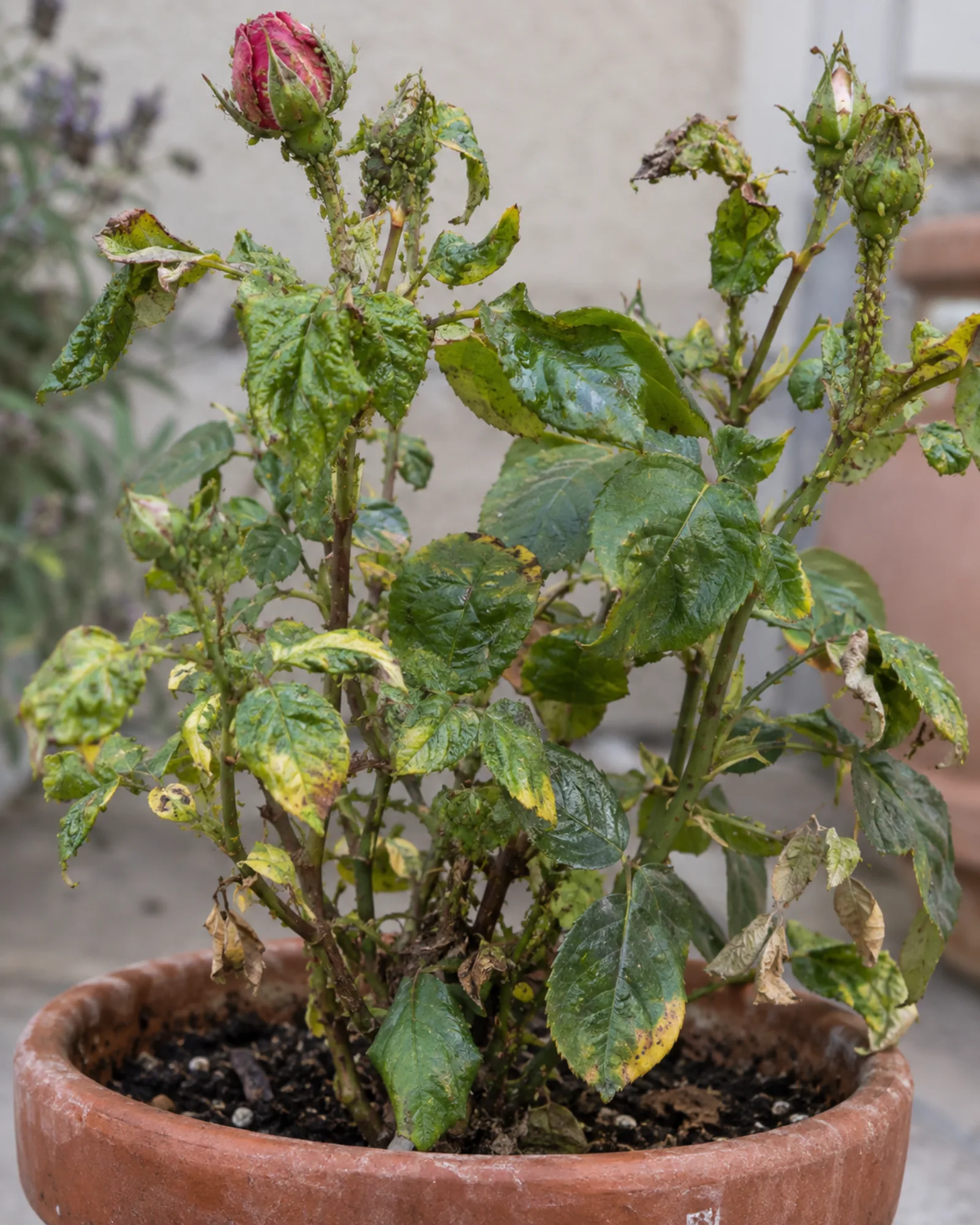
To tell it apart from look-alikes, remember that powdery mildew coats the leaf surface and rubs off, unlike downy mildew, which shows fuzzy growth on the leaf underside with yellow patches on top.46 Black spot, another common rose disease, makes distinct dark spots with fringed edges rather than a white film.46 And if the newest shoots are sticky and crowded with small insects instead of dusted white, the problem is aphids on roses, a pest rather than a fungus.
If the white coating starts on the newest growth and wipes off the top of the leaf, it is powdery mildew, not black spot or downy mildew.
What causes it and how it spreads
Rose powdery mildew is caused by the fungus Podosphaera pannosa.14 It overwinters inside infected buds, leaves, twigs and canes, and in spring those buds push out stunted, white, spore-covered growth.4 The spores are released as the infected tissue dries and are carried by wind to fresh new growth, where they start new colonies.4
Here is the part that surprises many gardeners: unlike most fungal diseases, powdery mildew does not need wet leaves to take hold. It thrives on warm days, cool humid nights, heavy dew and temperatures near 70F, and it spreads fastest in crowded plantings with poor airflow.24 Heavy rain and overhead watering actually work against it by washing the spores off and killing them, so it is often worst in dry-canopy, humid-night weather.24
Confirm it, and get a plan that fits
The signs above are usually enough to recognise powdery mildew by eye. If you would rather be certain, or you want a treatment matched to your rose and to how far the disease has spread, the CureMyPlants app can do that for you. It takes a photo and turns it into a rose-specific plan in about a minute. Here is how it works, in three moments.
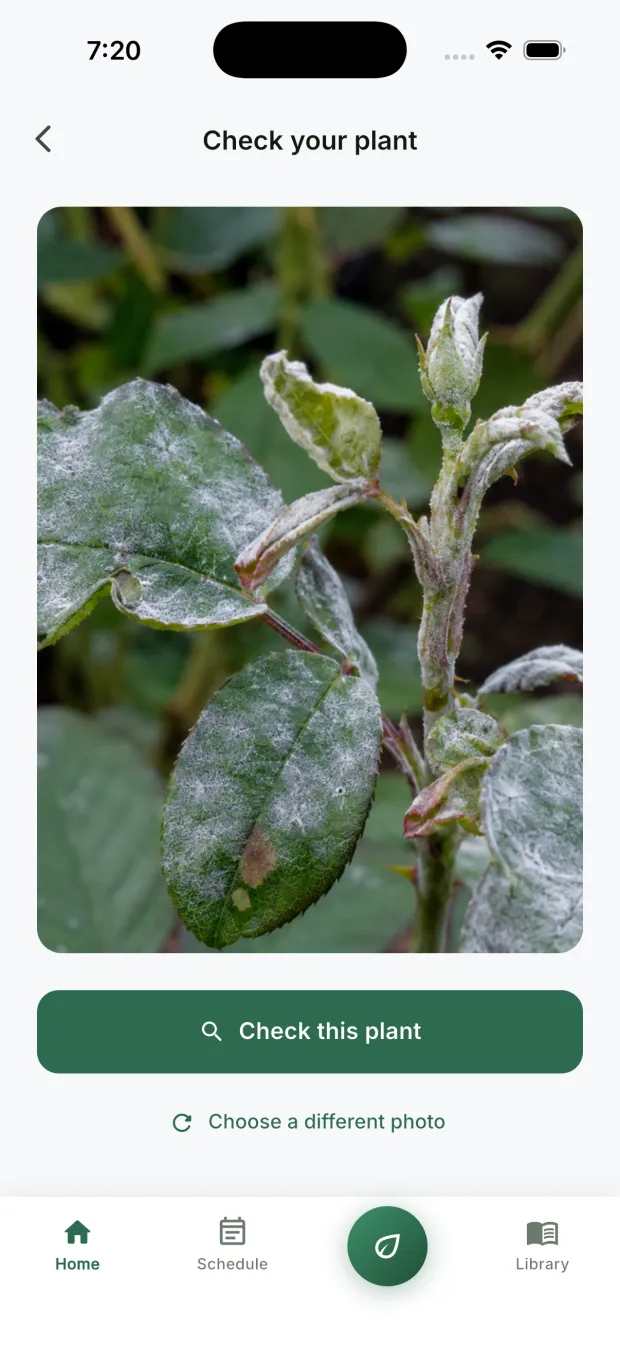
1 Snap and confirm
You take one photo, and it asks a plain question
No jargon and no plant Latin to learn first.
- One clear, close-up shot of the affected leaves and shoot tips is all it needs.
- It asks a couple of yes or no questions in everyday words to confirm what it sees.
- It shows a reference photo to compare against, so you are never left guessing.
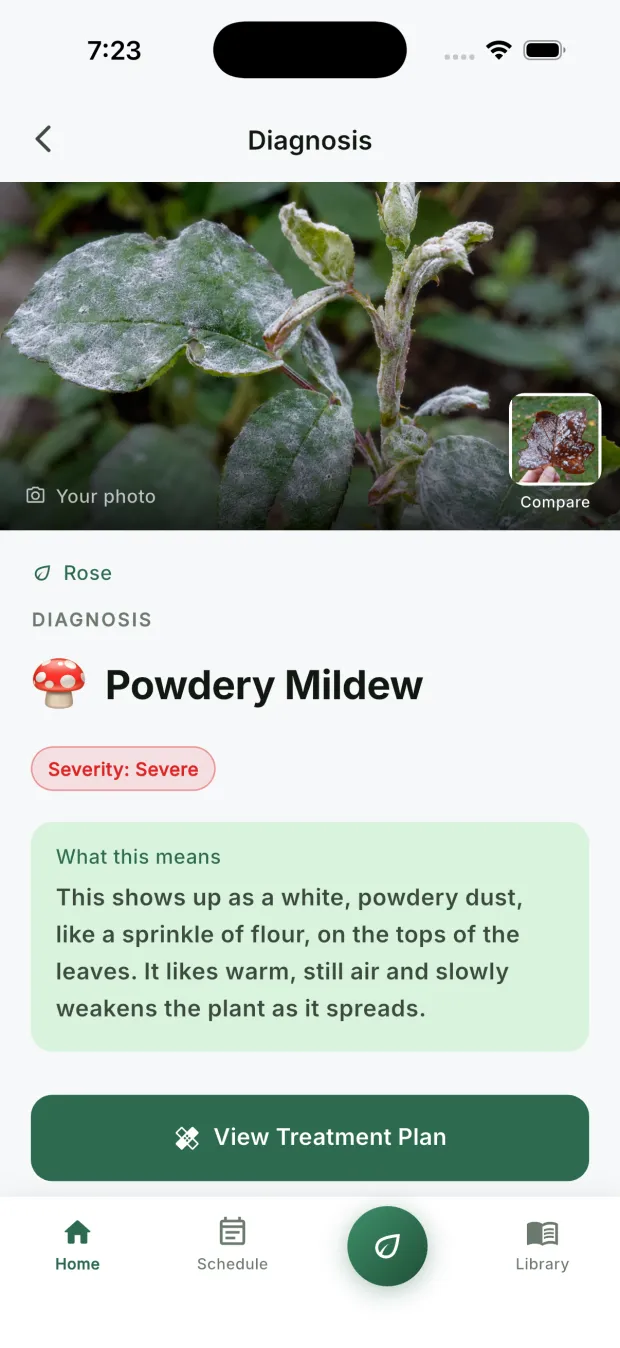
2 See the answer
The diagnosis lands on your own photo
Your own leaf, named and explained.
- The diagnosis in plain terms (rose powdery mildew), and what it means for the plant.
- A severity read, from mild to severe, so you know how urgent it is.
- A short explanation of why, written to be understood.
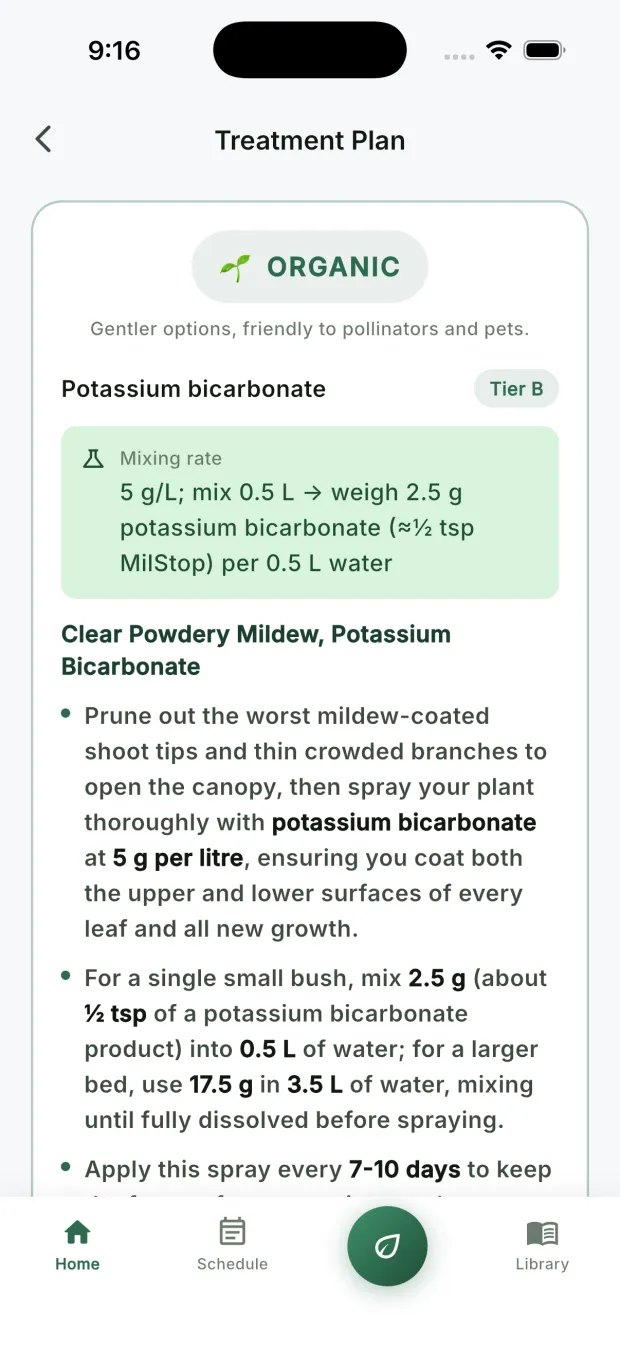
3 Get the plan
A plan built for roses, scaled to the case
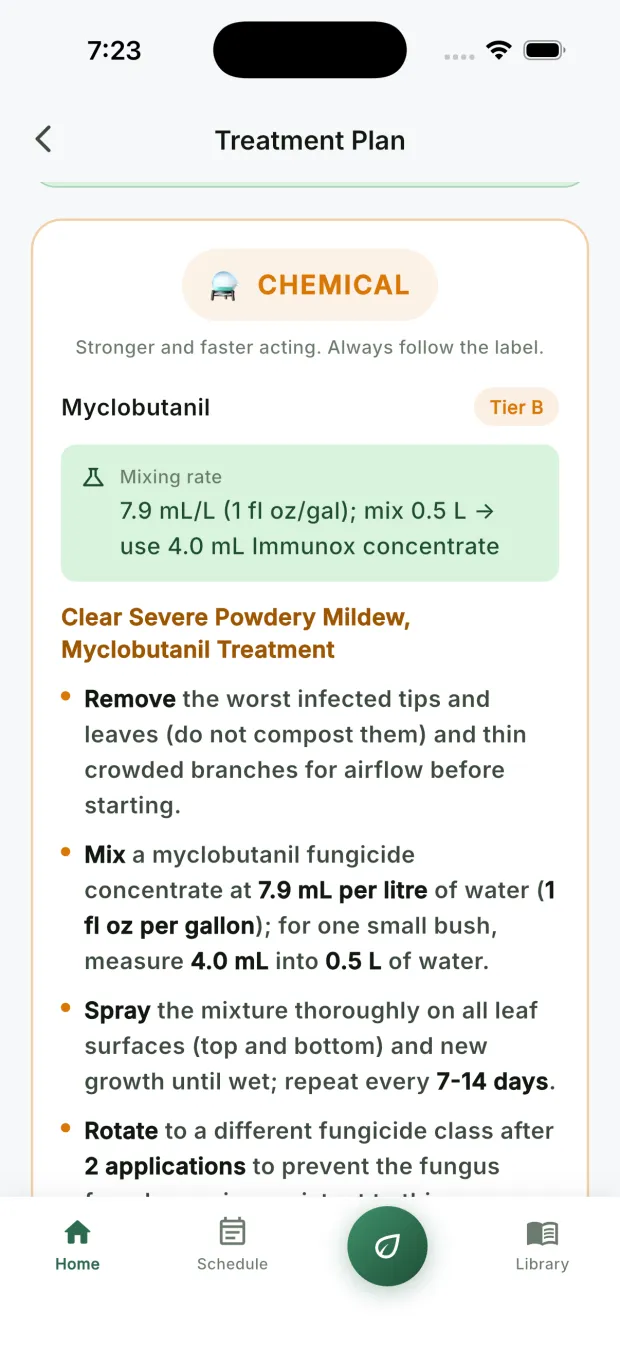
The same disease gets a different plan depending on how far it has spread. A milder case is met with a gentle organic spray first, potassium bicarbonate. A severe one, like the plant above, gets a faster chemical, myclobutanil.
The active ingredients that work
We talk in active ingredients, not brand names, so you know exactly what you are putting on your plant.
Organic options
- Sulfur is one of the most effective organic choices and a sound first line. It is a multi-site contact fungicide that interferes with the fungus's respiration and metabolism.1
- Potassium bicarbonate is a contact fungicide that shifts the leaf-surface pH and disrupts the fungal cell walls, with a low risk of the fungus building resistance.1
- Neem oil and horticultural oils physically smother the spores and threads of the fungus on contact.2
- Two biological options work in different ways. Bacillus subtilis disrupts fungal cell walls and membranes and releases antifungal compounds,7 while Bacillus amyloliquefaciens colonizes the plant surface and produces antifungal metabolites that suppress the fungus.1 These same biofungicides also help against tomato blight and the anthracnose leaf spot that troubles a fiddle leaf fig.
- An extract of Reynoutria sachalinensis (giant knotweed) works indirectly, by switching on the plant's own defenses.3
Chemical options (systemic, meaning they move inside the plant)
- Myclobutanil, propiconazole, tebuconazole and triflumizole are DMI fungicides. They block a key step in how the fungus builds the sterols in its cell membranes.13
- Azoxystrobin works differently, by interfering with the fungus's energy production.3
Recommended products
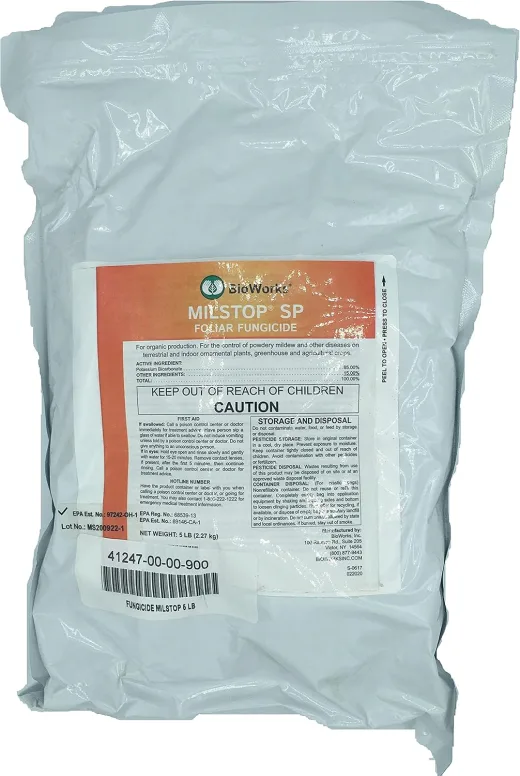
MilStop Organic Foliar Fungicide
A gentle, organic contact spray for early or mild powdery mildew. Reapply on a weekly schedule and cover both leaf surfaces.
View on Amazon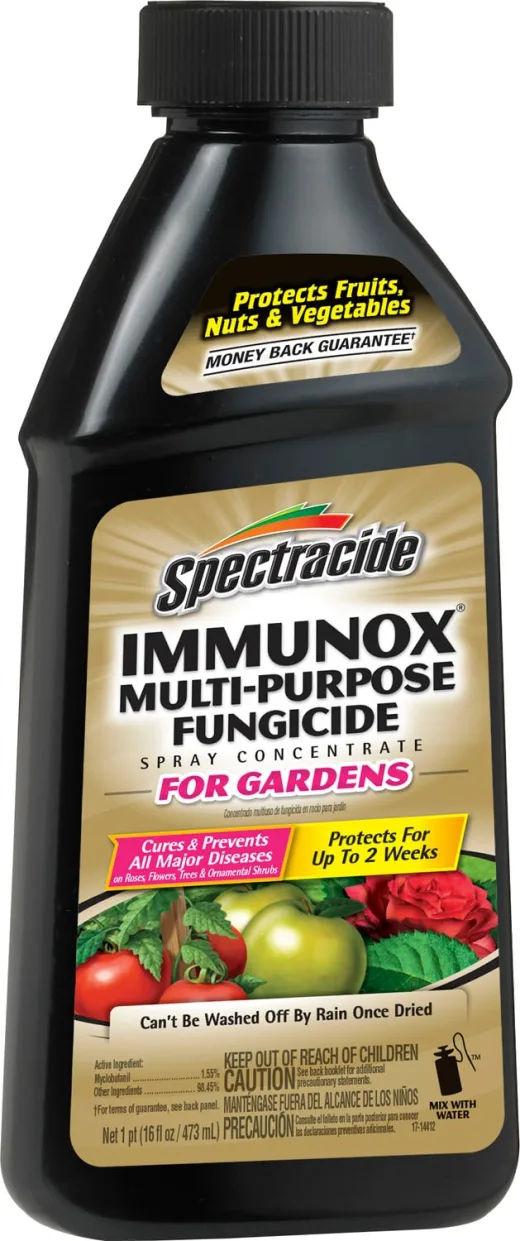
Spectracide Immunox Multi-Purpose Fungicide
A systemic option for stubborn or spreading infections. Follow the label rate and rotate with a different group to avoid resistance.
View on AmazonDisclosure: the links above are affiliate links. If you buy through them we may earn a small commission at no extra cost to you. We only recommend products we would use on our own plants.
How to prevent it next season
- Choose resistant varieties. Landscape roses such as Carefree Spirit carry extension-documented mildew tolerance,1 the popular Knock Out series is widely regarded as mildew-tolerant, though it is bred more for black-spot resistance, and Meidiland and Simplicity are also reported as more tolerant.2 Some newer series like Drift and Oso Easy are marketed as mildew-tolerant too, though that rests more on breeder claims. Resistance is not immunity, but it sharply cuts how often you need to spray.
- Open up the airflow. Space plants well and prune out crowded, crossing canes so the canopy dries and air moves freely, since crowding and still air are exactly what the fungus favours.16
- Water at the base. This does not change powdery mildew much either way, but keeping foliage dry helps prevent other rose diseases like black spot.46
- Clean up. Remove and bin the worst-affected shoot tips and fallen debris, so there is less fungus left to overwinter.4
Not sure what your plant has?
Snap a photo and get a clear diagnosis with a step-by-step treatment plan, free.
Diagnose my plantRelated guides
References
- Pacific Northwest Plant Disease Management Handbook. Rose (Rosa spp.) and hybrids, Powdery Mildew. pnwhandbooks.org
- UC Statewide IPM Program. Powdery Mildew on Ornamentals, Pest Note 7493. University of California ANR. ucanr.edu (PDF)
- UC Statewide IPM Program. Floriculture and Ornamental Nurseries: Powdery Mildew. ipm.ucanr.edu
- UC Statewide IPM Program. Roses: Diseases and Abiotic Disorders, Pest Note 7463. ipm.ucanr.edu
- Royal Horticultural Society. Rose powdery mildew. rhs.org.uk
- Clemson Cooperative Extension, Home & Garden Information Center. Rose Diseases. hgic.clemson.edu
- Agriculture and Horticulture Development Board (AHDB HNS 180, 2011). Fungicide treatments for sustainable control of powdery mildew on rose and herbaceous crops.